Posts

Showing posts with the label Chromosomes

MINISTRY OF DEFENCE

Image
  MINISTRY OF DEFENCE. Establishment Of National University In Islamabad Total position. 29 Domicile , All over Pakistan    Qualification  intermediate to bachelor positions . Project Engineer(Civil) account Officer  supervisor assistant office boy     How to apply.   Apply online through the link https://www.fgei-cg.gov.pk/nup-rec.php   Last date to apply  02 April 2023. No TA/DA Fo Interview 

Chromosomal Theory of Heridity

Chromosomal theory of Heredity Chromosomes contain genes and transfer the hereditary characters into new gener- ation. The function of chromosomes was explained by a German scientist Karl Correns in 1900. He considered the chromosome, as vehicles for the knowledge of hereditary. Later on a theory was proposed about chromosomes, by an American scientist Walter Sutton in 1902. This theory is named chromosomal theory of hereditary. The details of this theory are as follows: (1) Hereditary material within the nucleus: In reproduction two cells, sperms and ova participate in fertilization. Both gametes have equal contribution within the process. The male gamete contains little cytoplasm. So it indicates that hereditary material is present within the nucleus. (ii) Segregation of chromosomes: The chromosomes show the method of segregation (separation) during meiosis. This segregation is analogous to the Mendel's experiments. (iii) Haploid and diploid bodies: In rep...

Chromosomal variation,Variation in chromosomal number and morphology(Aneploidy,Euploidy & their types)

Chromosomal Variations Sometime due to somee reasons some changes OCCur in the morphology and number of chromosomes.  These changes are Visible phenotypically . Such changes are known as chromosomal variation. Chromosomal variations are as followS: 1.Variation in chromosomal number 2.Variation in chromosomal morphology 1. Variation in chromosomal number: In all living organisms the number of chromosome remain constant, but sometimes the variation in the number of chromosomes is called ploidy. It is of two types a.Aneuploidy or Heteroploidy b.Euploidy a.Aneuploidy or heteroploidy: During cell division when chromosomes are transferred into daughter cells sometime a changes occurs in the number of chromosomes, it is called aneuploidy or heteroploidy. *It is a change in the number of chromosomes, which do not involve whole set of chromosome, the change occurs in paris of a set only. In this process the chromosome number becomes unusual and abnormal. *Cause ...

Types Of Chromosomes & Chromosome as a carrier of gene

Image
Types of chromosomes on the basis of centromere The position and number of centromere may be variable According to the number of centromere, chromosomes are of following Types Centromere may be variable in different chromosomes. Acentric:   These are the chromosomes Witnout any centomere Monocentric : These chromosomes have one centromeree Dicentric:  These chromosomes have tw0 centromeres, Polycentric :  These chromosomes have more than two centromere. Types of chromosomes according to the position of centromere  ( Telocentric )  These are rod-shaped chromosomes these have  chromosomes at their proximal end. ii)Acrocentric:  These are also rod-shaped chromosomes but the centromere is between two chromatids in such a manner that one arm is short and another is long. iii)Sub-metacentric:  These are J or L-shaped chromosomes. In these. centromere is present in the centre in Such a manner that two unequal arms...

Chemical,Molecular and ultrastructure of Chromosome

Molecular,Chemical and ultar Structure Of chromosomes: Dupraw and Hans Ris proposed the theory about the molecular structure of chromosome, called Unistranded theory. According to this theory the chromosome consist of an elongated coiled fibre,called nucleo-protein fibre.in this fibre a double stranded DNA is present.The DNA is covered by histone and non histone proteins and RNA.the histone and non histone protein are equal in number. When in prophase stage,chromosome is treated with acetocaramine ,two distinct regions of chromosome are visible according to the amount of proteins,DNA And RNA. 1.Euchromatin regions 2 Heterochromatin regions 1.Euchromatin regions Closely packed and stains dark and transcriptionally active. 2.Heterochromatin Regions In 1928 Heitz The chromatin that is more densely packed and stained dark and inactive. Two types of Heterochromatin A Facultive Heterochromatin Some time condense some time uncondense. B.Constitutive Heterochromatin In suc...

Structure of chromosomes:

Image
Structure Of Chromosomes: Structurally the chromosomes consist of following parts 1. Chromatids 2.centromere or primary construction 3. Chromonema and chromomeres 4. Secondary construction or nuclear organizer 5. Telomere 1 Chromatids Chromosomes consist of two thread like structure called chromatids. 2. Centromere or primary construction: The chromatids are connected with each other by a small round structure called centromere (  In centromere the proteins are present which provide attachment with microtubules are called kinetochore. The position of the centromere is specific in the chromosomes. 3: chromonema and chromonemata: The chromatids are composed of two thin highly coiled filaments called chromonema or chromonemata. Each chromonema contains a double stranded DNA. Both chromonema are coiled in spiral manner and they also contain swellings on their surface called chromomeres ( structural subunit of chromosomes.the arrangement of chromomere struct...

What are chromosomes?

Image
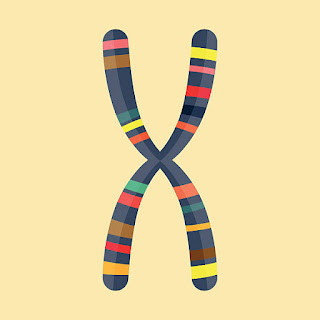
Chromosome Chromosome During cell division the chromatin material change into thread like structure called chromosome. Chromosomes are also called physical basis of hereditary. On the chromosomes small bodies are located call genes. There are thousands of genes are present in an organisms.Genes are the unit of heredity. These genes contain hereditary character which are transfered from one generation to another by the help of chromosomes. Chromosomes were discovered by a biologist waldyer in 1876. After that in  1908 Sutton identified the function of chromosomes,that they take part in the transfer of hereditary characters.      ( Next post will be about Structure of chromosomes)

Popular posts from this blog

Neurotransmitters and receptors

Excretion in Invertibrate,(Excretion in Planaria, Excretion in Earthworm,Excretion in Cockroach)

What are chromosomes?